
Wildebeest River Crossing Points
Remember, all our itineraries are totally flexible and can be changed to suit you.
Kenya and Tanzania Wildebeest River Crossing Points
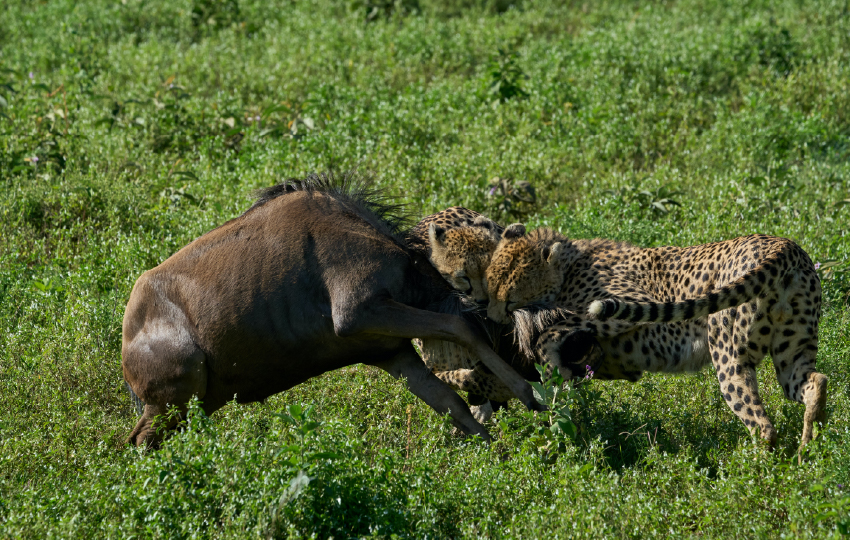
The Wildebeest Migration river crossing is a full year of continual event involving different episodes and sightings. There’s plenty of action to be found across the whole annual Great Migration, throughout the length of the places they migrate to. It’s a bloodbath, with the Big Cats such as lions, leopards, cheetahs, and even scavengers like vultures, hyenas, and silverback jackals following the herds step by step.
As much as the dramatic river crossings is exciting to watch, patience is needed to witness this sighting first-hand. The Wildebeests can take hours or even days to cross through the Mara and Sand River from the Serengeti in Tanzania to the Masai Mara in Kenya. With all that panic and confusion, the herds will impatiently wait for one of their members to take the first step, then they all follow through.
Most travelers consider the Masai Mara river crossings to be the most exciting part of the Great Migration – a bucket list experience. Here, the herds navigate steep jumps into the river, often at the mercy of strong currents in treacherous waters filled with deadly Nile crocodiles – not forgetting land-based big cats like lions, leopards, and cheetahs who lie in wait.
Best Wildebeest River Crossing Packages
Kenya and Tanzania Wildebeest Migration Safaris
8 Days | Kenya - Tanzania Safaris
10 Days | Kenya - Tanzania Safaris
10 Days | Kenya - Tanzania Safaris
10 Days | Kenya - Tanzania Safaris
Main Wildebeest River Crossings Areas
These crossings occur at various points along the Mara River during different phases of the migration, with some points being more active at certain times of the season than others. However, factors like rainfall and flooding can impact the timing of a wildebeest river crossing and where you can experience the best view. With that in mind, we’ll explore some of the popular river crossings points located at the banks of the Mara River and Serengeti Park, each with different characteristics and levels of activity during the migration river crossing season. Let’s see what makes each one worthwhile for your Great Migration adventure.


1. The Masai Mara River Crossing Points
The Maasai Mara River Crossings are amongst the most dramatic and sought-after spectacles of the Great Migration. Knowing where the wildebeest cross the river, can improve your great migration experience. However, the herds will at times miss crossing at certain points as mentioned below – these are just guides to let you know of popular crossing points in Masai Mara based on yearly great migration routes.
The wildebeests have many crossing points at the Masai Mara River. There is one, the Kichwa Tembo crossing point, and two crossing points within the Masai Mara National Game Reserve including the Lookout crossing point, Sand River crossing point, and Serena crossing points. These are just some of the expected areas where the wildebeest cross the Mara River.
As the Wildebeest herds begin to crisscross the Mara River on-to Kenya’s side in August, mentioned below are some of the best wildebeest migration crossing points in Masai Mara. Our knowledgeable guides will take you to the particular crossing points where they expect the wildebeests to cross the Mara River, a key aspect to note about the Kenya river crossings.
2. Lookout Hill Crossing Point
South of Masai Mara, the Lookout Hill Crossing is one of the first crossing points used by the herds as they move north from Tanzania into the Masai Mara. “The herds are free to choose from several crossing points too: Purungat, Peninsula, Fig and U crossing, the three Look-out crossing points, and Miti Moja crossing point. In addition, the look-out crossing points are particularly dramatic because the terrain here is relatively open providing great visibility for safari-goers; Moreover, the channels are narrow and up to six meters high, spacious enough to accommodate a number of tourist vehicles. “This crossing happens early in the migration season, around early August.
3. Cul de Sac Crossing Point
On the central Mara lies Cul de Sac or Kaburu crossing point, one of the most famous crossing points in the Masai Mara. Known for its narrow river opening, which forces the herds to come together in large numbers before crossing. This creates highly dramatic scenes, with chaotic stampedes and frequent crocodile attacks. Crossings here occur almost the entire crossing season, starting from the first crossing at this point.
4. Serena’s Crossing Point
Serena’s crossing is one of the most consistent, reliable and one of the easiest crossing points for the Wildebeests. This crossing point is not highly trafficked due to the limited open spaces and small hills that can harbor danger.
5. Mortuary Crossing Point
Mortuary Crossing is one of the final crossing points used by the herds as they head back south into the Serengeti. The name “Mortuary” refers to the high death rate at this crossing due to Big Cat’s attacks and crocodile ambushes. This will be at Mara Triangle areas.
6. Kichwa Tembo Crossing Point
Although timings might change or delay, around August – November period, lies the path of Africa’s remarkable annual Wildebeest Migration. Kichwa Tembo crossing point is one of the final crossings before the Wildebeest herd’s exit the Masai Mara and head back to Tanzania. In a private concession next to the Masai Mara, it is less crowded as compared to other crossing points, providing a quieter safari experience. You can further explore this incredible area on guided morning and afternoon game drives as well as on hot-air balloon safaris. As well, night-time game drives can also be arranged for a chance to search for the reserve’s elusive nocturnal wildlife.
Serengeti Wildebeest River Crossing Points
The story begins in the southern Serengeti at Ndutu area, and the short grass plains near Ngorongoro. Chasing the rains, fresh grass, water, and safe places to raise new life this has become nature’s most spectacular wildlife event. While the Mara River crossing is where so many popular Great Migration photos have been taken, let’s explore the river crossings in Serengeti.
The Wildebeest crossing points in Serengeti are numbered from numbers 1 to 10, where numbers four (4), seven (7), and ten (10) are the most popular crossing points for wildebeests in Serengeti Park. However, the herds will at times miss crossing at certain points as mentioned below – these are just guides to let you beware of the most popular crossing points in Serengeti based on yearly great migration routes.
The Wildebeests crossings at number 10 in Serengeti, end up crossing at Sand River in Masai Mara National Reserve, while numbers six (6), seven (7A), seven (7B), and eight (8) in Serengeti end up crossing at either Lookout or Sand River crossing points in Masai Mara Park. The ones that cross at numbers one (1) to five (5), most of them end up crossing at Serena, Lamai Wedge into Masai Mara. Mentioned below are some of the best wildebeest migration crossing points in Serengeti.
1. River Crossing Point 0
This river crossing, found at the very start of the Mara River route, is steep and has a more open landscape, giving guests a wider angle to experience the herds. Additionally, this is the initial crossing point as the wildebeest head north.
2. River Crossing Point 1
This is a key location just within the Serengeti, tourist vehicles can closely view the migration from Tanzania’s Lamai side of this river crossing. The River starts to widen, the crossing will start to become dangerous as crocodiles arrived to in the deeper water, and additionally the terrain is more challenging with steep ridges. It is a notable early crossing during the northward migration.
3. River Crossing Point 2
Positioned just north of Point 1, this crossing point is slightly easier to navigate. Offering a much wider view, this river crossing point is not as steep as the other crossings, although danger still lurks due to the presence of crocodiles and the flowing river current. The herds will manage to navigate the dangerous waters.
4. River Crossing Point 3
Though some crossings look closer to each other, the driving distance between them involves long kilometers of drive time. This crossing point is well-known for its chaotic crossings, large numbers of wildebeest congregate, leading to traffic jams, moving in solidarity to hold against the strong currents.
5. River Crossing Point 4
This is one of the most often used crossing points, providing an easier crossing for the Wildebeest herds. This crossing point is near the Kogatende area, on the Serengeti side. Crossing visibility can be somewhat restricted at this crossing, with viewing only allowed from the northern sides of the Mara River. Drama unfolds once the crossings starts, with the area characterized by rocky terrains adding more fun to the spectacle.
6. River Crossing Point 5
Located further downstream, this crossing point is closer to Kogatende airstrip. Often used during the mid to late migration season, the River crossing number five (5) is one of the more challenging crossing points for the herds due to its rocky terrains where they break legs or get stuck in the process, and with the strong currents, some will not make it.
7. River Crossing Point 6
Both points 6 and 5 present a challenge for the migrating wildebeests. River crossing number 6 has a small bridge to move from Southern side of the Mara to the northern side. This is a significant crossing area often used by large herds migrating south during their return migration from Masai Mara Reserve back into the Serengeti.
8. River Crossing Point 7A & 7B
Made up of two (2) river crossing areas namely seven (7A) and seven (7B), which are very close to one another but separated by a rocky creek, these points provide alternate crossing routes when the herd splits. The danger involves the challenging terrain, lots of predator presence patrolling the area; not forgetting the crocodiles lurking in the waters. Here, they need to come together to make it across the river safely, but as expected, some will still fall to the powerful jaws of the big cats or other predators at some point in the crossing.
Crossing at Makutano
Makutano is one of the most frequented crossing points. Herds can be sighted crossing for extended time periods. While this crossing point can accommodate many tourist vehicles where the river narrows along the banks, there are some restrictions in place so that vehicles don’t block the migration.
9. River Crossing Point 8
As the wildebeest begin migrating back south, this crossing point is much more important, allowing them to re-enter Serengeti National Park. Take note that the viewing here is to some extent restricted to the southern side, with safari vehicles at a distance of 30m from the herds. This crossing point still holds risks of river flooding.
10. River Crossing Point 9
This particular crossing area, is crucial during the later stages of the migration. Similar to river crossings at point eight (8), the area experiences many Big Cats sightings which will be trailing the herd. Positioned further north along the Mara River – watch as the wildebeests move together in mega herds, with crossing sightings lasting hours at a time.
11. River Crossing Point 10
Characterized by gentle slopes with no rocks, river crossing number ten (10) is alleged to provide an easier crossing area for wildebeest. Large herds crossing before they enter southeastern Serengeti. There is viewing restrictions to the northern side of the River, with access from the southern side.
Africa Wildebeest Migration Safari Key Stages
The Calving Season (around late January to March):
This period in the southern plains of Serengeti is when most wildebeest give birth to their young calves. The plenty of newborn helpless young calves means the arrival of predators, expect to see the big cats, jackals, cheetahs and hyena clans hunting easily due to the great numbers of wildebeest.
Start of Mating Season, moving north (April – May):
Next, the herds are making their way north along the grassier plains of the Serengeti’s western corridor. Mating season begins toward the end of May.
Grumeti River Crossing (June – July):
During this time, more so around June the wildebeest migration is often paused on the southern side of the Grumeti River. The crocodile-infested Grumeti River is one of the first problem that slow down the wildebeests on their migration from Tanzania to the Maasai Mara. Eventually, the wildebeest and zebras cross the perilous Grumeti River, trying their best to make it unharmed.
The Climax – Masai Mara River Crossing (July – August):
This is arguably the best time to witness the Great Migration as the herds brave the treacherous crocodile-infested Mara River, they are now moving quicker. It offers the best chance to see wildebeest river crossings, though they’re never guaranteed. Additionally, you also have a good chance of seeing predators taking down the weakest herd members.
Grazing in the Maasai Mara (September – October):
The wildebeest and zebras take advantage of the abundant grasslands in Kenya’s Maasai Mara. They will later on face the heavy waters of the Mara River once more as they prepare to cross once again for their return journey southward.
Back to Tanzania (November – December):
The short rains have begun, driving the wildebeest to leave the grasslands of the Masai Mara and head back into the Serengeti. The herds start their long journey back to Tanzania, where they will give birth to the next group of migrators.
Finally
Just to start the whole Serengeti Wildebeest migration all over again and again…
Africa Wildebeest Migration: When and Where...
Wildebeest Migration Safari In January
Around January every year, the wildebeest herds converge on the Serengeti’s eastern edge, and into the Ngorongoro Conservation Area. Between Lobo area, Naabi Hill, Kusini and Ndutu The herds are on the move freely in search of good grasses, and best conditions for raising their newborn calves. January is the beginning of what we refer to as the start of wildebeests’ calving or birthing season, and you may be rewarded with a few early calving sightings. Where are the wildebeest herds in January? Ndutu Conservation Area and Serengeti South.
Wildebeest Migration Safari In February
Around late January and February, the wildebeest herds move and now seen settling in their main calving grounds – around Ndutu and Kusini plains, the lower northern slopes of the Ngorongoro Crater highlands and around Olduvai Gorge. February is usually calving season in the Ndutu area and the southeastern plains: the very best time to visit this area; it’s an ideal location for wildebeests to give birth to their young, (nearly over 8 000 wildebeest babies are born each day!) – but with this, comes lots of danger from the predators who come for an easy kill. Where are the wildebeest herds in February? Ndutu Conservation Area and Serengeti South.
Wildebeest Migration Safari In March
March – In this period the best area to see wildlife is around Lake Ndutu, in the heart of the wildebeest gathering. Still on calving season; the wildebeest herds move slowly, while many newborn calves are fed. The Serengeti’s Ndutu, Kusini plains, and Maswa areas are home to the Serengeti’s wildebeest herds. Those interested in witnessing calving and the drama of Serengeti’s big cats on the hunt, the southeastern plains, mostly Ndutu is the place to be.
If the grass is good here, the herds will remain in Serengeti’s southern plains and the Ndutu safari area before they slowly start advancing. Where are the wildebeest herds in March? Central Serengeti
Wildebeest Migration Safari In April
In April, you can witness the herds along the plains in the Naabi and Kusini areas. Furthermore, the newborn calves have reached an age where they can move, forcing the wildebeest herds to prepare for their march onwards. They are joined by many zebras, and a scattering of Thomson’s and Grant’s gazelles. In addition, towards late April the (mating) season slowly begins. Where are the wildebeest herds in April? Central Serengeti
Wildebeest Migration Safari In May
In the month of May, as the calves’ legs now become fully functioning, the herds are moving a little quicker now that the calves are stronger, allowing them to cover long stretches of several kilometres. At this time to you may have the opportunity to witness more than a million marching wildebeests in a column, covering up to 40 kilometers (approx. 25mi) long. The herds start to congregate by the Moru Kopjes and west of Seronera, a popular path of migration.
They will later on be sighted in Simba Kopjes and Moru Kopjes in the Central Serengeti for much fresher grass, accompanied by the thousands of zebras and smaller groups of antelopes. Their movement is northwest moving through the plains of Simba Kopjes and Moru Kopjes towards the direction of Seronera Valley.
Mating season continues, and is in full swing, expect to see violent fighting between competitive males as they compete for the attention of females.
During this month, the migrating herds are seen traveling slowly towards the Serengeti Western Corridor, south of the Grumeti River, and moving along with them are the, zebras and gazelles among other plain animals grazing as they march along. Where are the wildebeest herds in May? Central Serengeti
Wildebeest Migration Safari In June
During the month of June, the wildebeest herds form in huge numbers along the pools and channels of the river in the Western Serengeti Corridor, and on the southern banks of the Grumeti River; this is where they will face the first major challenge – crossing the Grumeti River. Now this is the time to go for a Serengeti wildebeest migration, anytime between late May and early June.
Even if – this may not be as good as the famous Masai Mara migration crossing, each of them must face the challenge of crossing the crocodile-infested river — the first of their tense river crossing encounter. If at this time you’re on a safari in Serengeti National Park, you can watch the wildebeest cross the Grumeti River. Additionally, the migration can at times be challenging on this south side of the Grumeti River, which has some channels which slow down their migration north, some of the herds may have split up, with others already crossing the Grumeti River. Where are the wildebeest herds in June? Central Serengeti
Wildebeest Migration Safari In July
The wildebeest herds are still in the chase for greener grass & water, they are now migrating quicker as they head north along the western edge of the park towards a more dangerous place – the Masai Mara River in the northern part of Serengeti.
In July, the Great Migration has arrived at the Grumeti region, and Ikorongo, others at the northern parts of the Serengeti and are now moving closely at the dangerous waters of the Mara River where they must cross over into Kenya.
As mentioned, it is impossible to accurately predict migration river crossings – they usually begin at the start of high season in July, but timing all depends on nature, the rains and also the unpredictable wildebeest themselves.
Tip – It’s important to book your Wildebeest Migration tour in Africa up to a year or months in advance to get a good safari lodge in or camps close to the Mara River – this helps avoid the travel time to river look-out points for the sightings. In addition, the wildebeest have their own historical crossing points and you may spend days waiting on them in the hope of seeing the action.
We further recommend choosing a mobile safari camp that also moves as the migration moves to ensure you’re in the right place at the right time. Where are the wildebeest herds in July? Serengeti North
Wildebeest Migration Safari In August
The migration has arrived, this is when all the drama unfolds: the Wildebeest herds will now attempt to cross the Mara River’s crocodile-infested waters. It’s generally considered the best time to witness the river crossings from the northern Serengeti into the Masai Mara. Remember, the Mara River crossing is where so many iconic Great Migration photos have been taken.
Watch the panic and the confusion at the crossings — combined with waiting predators and heavy water currents — where other are swept away, and even with the gently flowing waters, the deadly Nile crocodiles await them as they cross, not to mention the lions, leopards and other large predators that patrol the river banks, ready to attack any wildebeest that make it to the other side. At this time, daily river crossings can be seen at the Mara River and Talek rivers, both often central to good scenes.
By August, the herds have successfully made it across the Mara River spread out in the Masai Mara’s northern region, and Masai Mara National Reserve in Kenya, with others remaining in the northern Serengeti. August – September period is considered being a bad time to visit Serengeti National Park and see the Great Migration as the herd moves into the Masai Mara in Kenya. Where are the wildebeest herds in August? Masai Mara National Reserve, Kenya
Wildebeest Migration Safari In September
By September, most of the wildebeests have already crossed the Mara River, and the majority of the herds will be in the Greater Masai Mara area, grazing the lush green grass before slowly breaking up into smaller groups moving north towards the private conservancies (Mara North, Olare Orok). The Masai Mara is the best place to witness the Migration safaris. Where are the wildebeest herds in September? Masai Mara and Northern Serengeti
Wildebeest Migration Safari In October
By October, your best bet is still the Masai Mara. The weather is still good, and the wildebeest herds are in Masai Mara, but are preparing to start their slow movement back into the Serengeti moving southward through Loliondo in the east, and the Serengeti National Park’s Lobo Valley region and Grumeti Reserve, returning to the now green-grasslands. This usually happens in October, but sometimes earlier. Where are the wildebeest herds in October? Eastern and Central Serengeti
Wildebeest Migration Safari In November
November, the short rains have begun, and the herds have now left the north and are slowly passing through the Lobo region toward the central Serengeti. Keep in mind that the rain can be late or early, which is also unpredictable. As the herds pass the area in November, they attract a huge number of hyenas, leopards, and lions which can be spotted on the rocky outcrops. Where are the wildebeest herds in November? Central Serengeti
Wildebeest Migration Safari In December
By December, the wildebeests are spread throughout the eastern Serengeti to the southern reaches of Ndutu. With the short rains starting to fall, the herds will move quicker now, as far south as possible, towards the Southern Plains which they usually reach within a couple of days; back to their calving grounds full of fresh grazing grass, drawing these herds of wildebeest and hundreds of thousands of zebras and other plains animals.
They are now ready to calve in the south and begin the great cycle all over again and again… Where are the wildebeest herds in December? South Serengeti and Ndutu Conservation Area.
Wildebeest Migration Safaris FAQs
Q. When does the wildebeest migration happen in Tanzania and when is the wildebeest migration in the Masai Mara, Kenya?
In general, the great migration crossing is always awaited during the months of July to October as it’s when the best sightings are seen as they jump and cross these Crocodile-infested Mara – Serengeti Rivers. You can easily book some of our best Masai Mara migration packages, or Serengeti migration safaris, well-curated to ensure you enjoy the migration crossings to the fullest.
Therefore mark your calendar as from July – October when the wildebeest are always crossing the Mara River into Kenya. This is when to book wildebeest migration safari packages. The herds are sometimes crossing the Mara River from one side of the Masai Mara to the other (all in Kenya).
Q. Where are the best places to stay on a migration safari?
Accommodations for a great migration safari are divided into two categories: the permanent lodges and mobile tented camps.
Each have different advantages, but choosing one depends on what is important to you:
For an unforgettable migration river crossing safari experience, it’s best to stay at accommodations located within or near the Maasai Mara National Reserve; – known for its prime location along the wildebeest migration route and river crossings. Stay in top lodges and camps located near the Mara River for the best sightings & shorter drive times to where the herds are crossing.
Q. Where are the best places to see the wildebeest migration?
With good big 5 safari tours, choosing between Tanzania and Kenya to spot the Great Migration depends on the time of year. Mobile camps are great as they move with the herds, ensuring optimal viewing. Permanent lodges around key crossing points and calving areas also offer excellent opportunities to witness the migration. There exists lots of good Serengeti migration accommodation options to choose from; – plenty of well-located river crossing accommodations both in the Masai Mara National Reserve and Serengeti Park, enabling you to experience an unforgettable wildebeest migration in Serengeti and Masai Mara.
As to where to stay during a river crossing, let’s take a look at some of the best wildebeest migration safari accommodation; these are accommodation options that cater to many different travelers. Whether you seek to explore the best of Kenya luxury lodges, luxury lodges in Tanzania, boutique hotels, or cozy beach cottages, or idyllic beach bungalows – the choices are practically endless.
With that in mind, these are just some highlights of the best places to stay for an African migration safari;
- Serengeti Pioneer Camp, Tanzania
- Grumeti Serengeti River Lodge, Tanzania
- Bateleur Camp Masai Mara, Kenya
- Serengeti Under Canvas, Tanzania
- Singita Sabora Tented Camp, Tanzania
Instead, just get in touch with one of our African safari experts to help you find a lodge that’s right for your Great Migration safari: We’ve designed a list of our top 10 places to stay to see the wildebeest migration. We’ll not only help you find some of the best wildebeest migration camps and lodges, but also curate a once in a lifetime migration trip in Africa.
Q. What time of the year is the wildebeest migration?
Though the great migration includes different phases, the main crossing usually happens at Mara River around late July to August with parts of September and again on their return south, around the last two weeks of October through early November. Still, the exact dates around this period are not predictable Hence, if you’re planning a Serengeti migration safari, plan around those dates. At times the herds can gather at the river banks for days without crossing over to the Mara, some patience is required; – making the exact answer on when to go on a wildebeest migration safari somehow based on you interests.
Q. What is the best time to visit Masai Mara to see the migration?
For you to witness a migration river crossing in Masai Mara, the best time to visit is from late July to early August and minimal parts of October when the herds arrive from the Serengeti and cross the Mara River. Keep in mind that at times the herds may not show at certain crossing points therefore adding flexibility and patience on your migration safari really helps.
Q. Where do the wildebeest migrate to and from?
The wildebeest usually migrate from southern Serengeti into Masai Mara in the Northern side on a ring-like path through Tanzania and Kenya as they follow the seasonal rains, and navigating through dangerous territories and crocodile-filled waters. Their return journey back to Serengeti Park happens around late or early October. Therefore keep in mind wildebeest migration in Masai Mara is much popular as compared to the ones at Serengeti; but also, our top picks for holidays to Tanzania features the beginning phases of the Migration as it starts in Tanzania making it a good time to go and see where it starts.
Q. How do you see the wildebeest migration?
The way to see a migration crossing is while on a game-viewing drive in the Masai Mara National Reserve, or Serengeti – which is done in custom made 4X4 safari vehicles accompanied by experienced driver-guides. For the best Masai Mara migration packages, on accommodations, we recommend booking safari lodges located inside Masai Mara Park. This reduces the drive times to the Mara River where crossing will be taking place.
Q. Which is better, Grumeti River or Mara River Crossing?
The Mara River crossing usually takes place between July and August, while the Grumeti River crossing usually happens in late June and/or early July. While witnessing the river-crossing herd is undeniably breathtaking, it’s important to note that these events are random. Herds may just arrive and delay by the river for days, or weeks making their strategies for a safe passage.
When choosing between Grumeti and Masai Mara migration, remember that accommodation is better established in the areas surrounding the Mara River, with good options to suit the budget traveler.
Secondly, the chances of seeing a river crossing are much higher at the Mara River, since the crossings tend to occur more frequently. Additionally, at the Mara River, the migration crossing is much more dramatic as the river is flowing faster, much deeper and made up of steep river banks, creating a jumping circus unlike the Grumeti River which is somehow just open and shallow – therefore not challenging.
Q. When is the best time to visit Grumeti River?
Even though a safari in Grumeti is fantastic all year-round, it’s much better when the great migration herds passes through, usually around late June and/or early July, crossing the crocodile-infested Grumeti River on their way back to Kenya’s Masai Mara. Now this is the best time to visit the Grumeti River to witness river crossings; catch the drama our favorite Serengeti wildebeest safaris.
Q. What is the cost of a great migration safari?
So how much is a migration river crossing safari? On average, the price of the great migration safari costs around $700 to $1,200 per person per day, offering an unforgettable and exclusive experience. You’ll stay in top safari lodges that offer premier game-viewing opportunities, and enjoy fine amenities, spacious rooms with en-suite bathrooms, and exceptional dining experiences. With additional activities hot air balloon safaris, guided safari walks, horse riding, game drives, spa treatments, swimming pools and infinity pools at your disposal. There is also child-friendly activities and programmes for those going on a safari with kids. Therefore, “don’t be surprised to see wildebeest migration safari adventures in Africa costing around US$1,000 a night.
Q. What type of vehicles can I expect on a great migration?
As for the vehicles to be used on a great migration safari holiday, all of migration tours use the best-quality safari jeeps. Expect both the 4×4 land cruiser with open rooftop and open sided 4×4 safari jeeps are available. The vehicles are built to withstand the bush terrain offering a fairly smooth ride over even the bumpiest roads. Both cruisers have raised seats ensuring every traveler has a 360 degrees view of the animals no matter which side of the vehicle they are on. Additionally, the windows are large providing some up-close encounters with curious Big Cats! Most of the vehicles will have cool boxes filled with water, power sockets for charging camera batteries and camera support bases for those going on Africa photo safari tours.
The professionality of the driver and guide is as important as the quality of the vehicle. On a luxury safari, are expect highly trained driver and guides who have outstanding wildlife knowledge. Expect them to always switch off the vehicle engine when you want to see an animal or stay much longer on a sighting. They will always try and position the vehicle so that you have the best viewing angle of the wildlife. Expect short briefs even during an animal sighting where you will see them turn and face you when they talk. Keep in mind our luxury fly-in safaris are also available if you wish to explore this option. Ready to start planning your trip? Discover some of the best wildebeest migration tours & safaris that put you right in the middle of the action.
Q. What time of the year do the wildebeest migrate?
Most people think that the Wildebeest Migration only takes place between peak seasons from late July to October, but it’s actually an ever-moving, circular migration filled with several exciting events that occur year-round. Throughout the year, there’s plenty of wildebeest migration safari packages covering every phase of the cycle.
Q. Where does the great migration start?
The famous Great Migration river crossing, begins after calving in the southern plains of Tanzania’s Serengeti near the Ngorongoro Conservation Area, where herds of wildebeests, zebras, and other herbivores migrate north towards the lush grasslands of Kenya’s Masai Mara National Reserve, then back again, over and over again… yearly.
Q. Why do wildebeest herds migrate?
The wildebeest migration is a yearly spectacle where millions of wildebeest, together along with zebras, and gazelles migrate across the plains of East Africa in search for water and fresh grazing grounds, water, and safe places to raise new life. The Wildebeest herds migrate primarily following the rainfall patterns and fresh grazing grass, a crucial cycle for their survival and breeding.
Q. What should I pack for a great migration tour?
While the normal safari clothes and equipment’s apply, let’s see some few extra additions from our list below – which might be just what you need to experience the wildebeest crossings in the best way possible.
Kindly make sure you have the necessary travel documents to ensure a smooth journey to your Great Migration adventure.
Passport: Make sure your passport is valid for at least six months beyond your planned date of departure from Africa. Also, ensure you have at least two blank pages for visas and stamps.
Visa: Depending on your nationality, you might need a visa to enter countries like Kenya or Tanzania, where the Great Migration can be witnessed. U.S. and European citizens need to apply for an e-visa for holidays in Tanzania. While Kenya offers visa-free entry, all foreign visitors – U.S. and European visitors are required to fill an Electronic Travel Authorisation (ETA) 72 hours prior to their travel. It is best to arrange this before departure to avoid any potential delays at the airport.
Your Travel Insurance: Comprehensive travel insurance that covers medical expenses, trip cancellations, and baggage loss or theft is highly recommended. Make sure it includes coverage for any safari activities you plan to participate in.
Vaccination Certificates: Depending on the current health guidelines and requirements, you might need to show proof of certain vaccinations, such as Yellow Fever. Check if the countries you are visiting have any specific health requirements.
Flight Return Ticket: Some countries might require you to show proof of a return ticket or an onward journey to grant entry.
Itinerary Details and Accommodation Confirmations: Having a copy of your travel itinerary and confirmed hotel reservations can be helpful at the immigration desk.
Emergency Contacts and Important Addresses: Carry a list of emergency contacts, including your country’s embassy or consulate in the countries you will visit, as well as the addresses and contact details of your accommodations.
Q. Is it only Wildebeest herds which migrate?
No, it’s not only wildebeest that migrate; they migrate together with thousands of zebras, topi’s, eland and gazelles forming one mega herd; – in their circular movement across the Serengeti-Mara ecosystem in search of food and water.
Q. Ready for your migration safari? Our recommendation
You can explore more of our migration questions not covered here, don’t spend hours researching online asking;- Is July a good time to see the great migration? Is August a good time to see the great migration? Or Is September a good time to see the great migration? We’re here to help you out with all this.
Q. Ready to Plan Your Migration Safari?
Fortunately, we’ve been planning wildebeest migration safaris in wildebeest migration safari in Kenya & Tanzania since 2018. We’ve helped thousands of travellers to be in the best possible place at the best possible time for the best possible price. If you’re looking for expert planning advice, look no further. Discover the best Tanzania wildebeest migration safari packages where we’ve compiled all our specialist tips in this handy beginner’s guide to a wildebeest migration safari in Africa.
With climate change, the long and short rainy seasons in Tanzania and Kenya are no longer as regular or predictable as they once were. The rains can be late or early, which will throw the whole wildebeest calendar out of synch. Therefore, for the best migration safaris in Tanzania, this is once again why it’s important to plan for as much time on safari as possible. You cannot do a Kenya fly in safari for two nights, see a river crossing and fly out again for wildebeest migration Tanzania safaris – nature simply doesn’t work that way.
Q. Tips for planning your migration safari?
Migration safaris in Kenya remains one of the most sought-after experiences for wildlife and nature enthusiasts. For the best Kenya wildebeest migration safari packages make a visit to the Masai Mara. The Great Migration is the ever-moving circular migration of over a million animals across the Serengeti-Mara ecosystem.
Looking forward to booking the best migration safaris in Kenya? Keep in mind that it is unclear how the wildebeest know which way to go, but it is generally believed that their journey is dictated primarily by their response to the weather; they follow the rains and the growth of new grass. While there is no scientific proof of it, some experts believe that the animals react to lightning and thunderstorms in the distance. Book your wildebeest migration Kenya safaris today.